

Capricorn and the Rune Wheel: Hagalaz, Isa and the Structures That Survive
In a strong earthquake, the buildings that survive are not always the most rigid ones. Engineers learned this the hard way. A building has to be stiff enough to stand, and flexible enough to sway. Too soft and it collapses under its own weight. Too rigid and the first real shock cracks it from top to bottom.
Capricorn builds things that are meant to last: careers, institutions, reputations, families that can rely on it. Sooner or later, every one of those structures meets its earthquake. How it comes through depends on the same balance the engineers found.
In the AskRunes rune wheel, the tenth house belongs to Capricorn and holds two runes that describe that balance exactly: Hagalaz, hail, the shock from outside, and Isa, ice, the strength to hold a shape.
The Tenth House: Reality That Does Not Negotiate
The tenth house is where we meet the world as it actually is. Not as we hoped it would be in the ninth house, and not as we feel it should be at home in the fourth. Deadlines, laws, budgets, markets, bosses, the limits of time and of the body: the tenth house is everything that does not change because we want it to.
It is also the house of our public role. Career, status, responsibility, authority, the place we hold in the eyes of others. The father and the boss belong here, both as figures we meet and as roles we may one day take on. Whatever we build in the first nine houses gets its final, visible shape in the tenth.
That shape will be tested. It is not a question of whether, only of when.
Hagalaz and Isa: The Blow and the Bridge
Hagalaz: the coldest grain
Hagalaz is hail. The Norwegian rune poem calls it the coldest of grains, which is a sharp image for a farmer: something falls from the sky like seed, and instead of feeding the field, it batters it.
As Capricorn's outer rune, Hagalaz is the shock that reality delivers to anything built. The market that turns, the reorganisation, the failed project, the illness in the middle of a career. It is disruption from outside, and it is not personal. Hail falls on every roof. What it shows is which roofs were built well.
Isa: the broad bridge
Isa is ice, and the Norwegian poem gives it an unexpected name: the broad bridge. For people in the North this was literal. In winter, frozen rivers and lakes became roads. Places that were cut off all summer could be reached across the ice.
As the inner rune of the tenth house, Isa is endurance, discipline and commitment: the ability to hold a shape long enough to cross something that could not be crossed otherwise. A degree finished, a business kept alive through a bad year, a promise kept for a decade. This is Capricorn at its best.
The same poem adds a warning in its second line: the blind must be led. Ice is also what freezes us in place. In excess, Isa becomes rigidity: the person who holds everything up alone, like Atlas with the sky on his shoulders, and no longer sees that most of that weight could be set down.
Hagalaz tests the structure. Isa is what lets it stand, and what can make it too stiff to survive.
Too soft, too rigid
Hagalaz without Isa is storm after storm with nothing to hold. Every setback knocks the person over, every change becomes a crisis, and the career looks like a series of new starts after collapses. Sometimes this person blames the weather; sometimes they become the hail themselves, the one who shakes up every place they work and builds nothing that lasts.
Isa without Hagalaz is the rigid building that has never been tested. Rules kept because they are the rules, a career plan followed long after it stopped making sense, an authority that cannot bear to be questioned. It looks solid for years. Then the first real shock arrives and the whole thing cracks, because nothing in it was ever allowed to bend.
The healthy tenth house is the engineer's building: firm where it must be firm, flexible where it can afford to be, and tested often enough to know which is which.
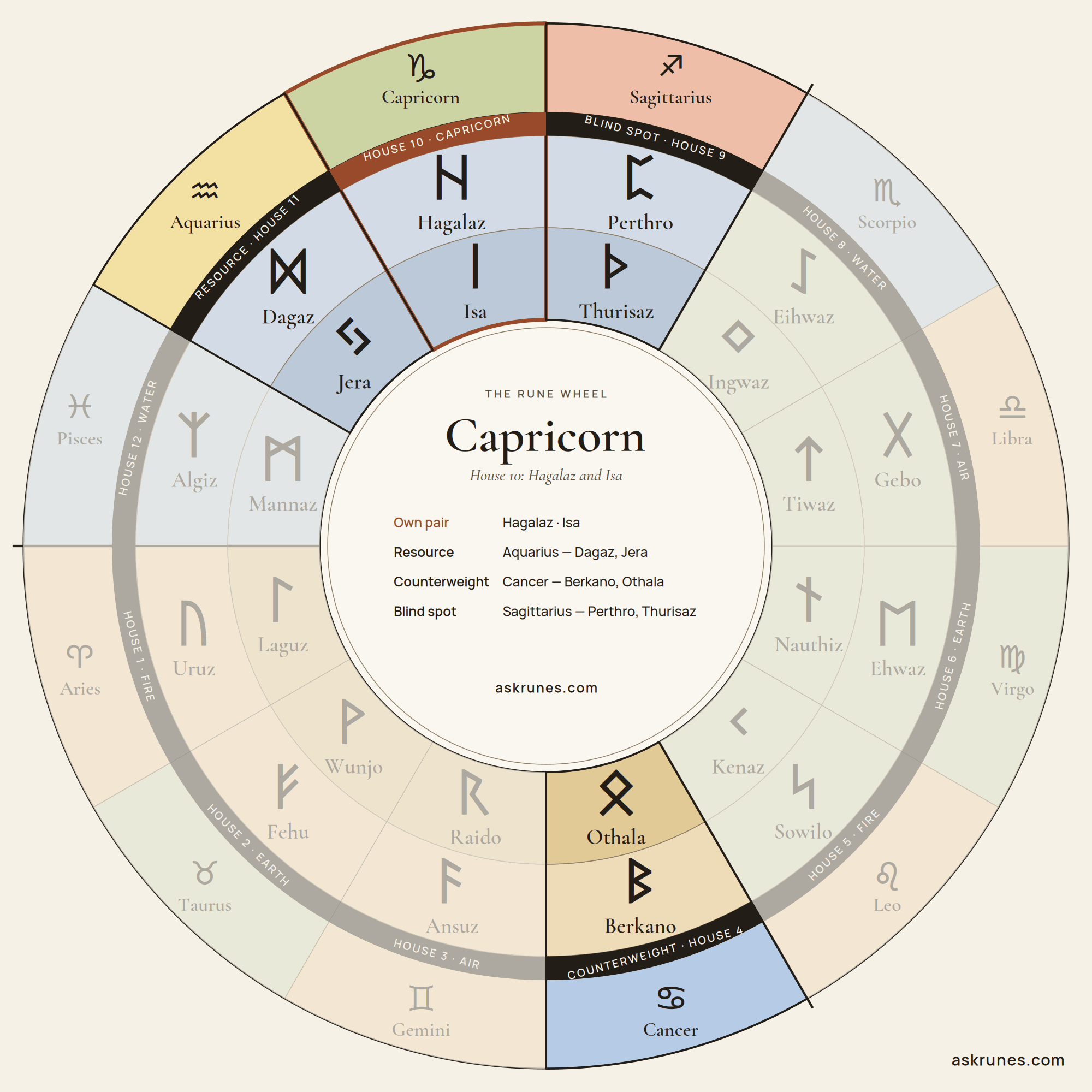
Capricorn on the AskRunes rune wheel: Cancer across, Aquarius ahead, Sagittarius behind.
The Foundation: Cancer Across
Opposite Capricorn stands Cancer, with Berkano and Othala. The axis between them runs from the demands of the world to the base that makes meeting them possible.
Capricorn's typical mistake is on its own side of this axis: giving up all rest and support to meet the world's demands. I will rest when this project is over. I will see the family properly after the promotion. I will slow down when I retire. A building can carry an enormous load, but only if its foundation is sound, and the foundation of a working life is the place where you are looked after.
Berkano is exactly that: care, received rather than given. Capricorn is often very good at providing for others and very bad at letting itself be provided for. Othala adds roots. Ambition that remembers where it came from, and for whom it works, stands more steadily than ambition that has cut every tie to prove it needs none.
Where the counterweight ends
Cancer can be overdone from Capricorn's side too. A retreat to the safety of home can become a way to avoid what has to be faced: the difficult decision at work, the responsibility nobody else will take, the exam that keeps being postponed. Then the foundation has become a hiding place.
A test for the axis: Is this rest that restores me, or a retreat from something I have to face?
For Cancer's view of this axis, read Cancer and the Rune Wheel.
The Thaw: Aquarius Ahead
The sign after Capricorn is its resource: Aquarius, with Dagaz, daybreak, and Jera, the year and its harvest.
Every winter ends. That is the simplest thing Aquarius can tell Capricorn, and the hardest for Capricorn to believe. Jera is the turning of the year: ice that melts in spring, work that bears fruit in its own season and not before. A structure that knows its season can hold on through the cold without mistaking the cold for forever.
Dagaz brings the new light that keeps structures alive: a fresh idea, a different way of doing things, the moment the old hierarchy suddenly looks optional. Institutions that never let Dagaz in slowly turn into monuments.
Aquarius also gives Capricorn something it rarely has: peers. Capricorn's climb tends to be lonely. It knows the people above and the people below, but not many who stand beside it as equals. The eleventh house is the house of friends and shared hopes, and it is where Capricorn can put down its authority for a while.
Ask yourself: Who are my peers, the people who are neither above me nor below me?
Aquarius' own lesson is told in Aquarius and the Rune Wheel.
The Hidden Load: Sagittarius Behind
The sign before Capricorn is Sagittarius, with Perthro and Thurisaz, and it is Capricorn's blind spot.
Every structure Capricorn now defends began as someone's gamble. The company was once a risky idea, the career was once a leap, the rules were once somebody's new belief. Perthro, the throw of the dice, is how most of what Capricorn manages came into being. Capricorn tends to forget this and treat the present order as if it had always existed.
Thurisaz hides something more personal. Many Capricorns were rebels once, before they became responsible. The one who questioned every rule is now the one who enforces them, and often without asking whether they still believe in them. The ninth house is the house of belief, and Capricorn carries a great deal of belief it has never looked at.
Ask yourself: Which of the rules I enforce do I actually believe in?
For Sagittarius' own story, read Sagittarius and the Rune Wheel.
A Practice: Set Down One Weight
Think of everything you are currently holding up: at work, at home, in your family. Now choose one weight among them that is not truly yours, or that you are holding far more tightly than it needs.
For one week, set it down. Delegate it, say no to it, or simply stop checking on it every day. Watch what happens.
Most of the time, the sky does not fall. When it does not, you have learned something about Isa that no amount of reflection could teach. And if something really does start to crack, you have found a load-bearing wall, which is worth knowing too.
You can combine Hagalaz and Isa in the Bindrune Generator. For practical rune work with this sign, see our guide to Capricorn and Norse Runes, and for a question about your own work or responsibilities, choose a rune spread.
Frequently Asked Questions
Q: Is the tenth house only about career?
A: No. Career is its most visible part, but the tenth house covers every meeting with objective reality: responsibility, authority, status, rules and limits, and the figures of the father and the boss.
Q: Why does Capricorn get two harsh runes, hail and ice?
A: Because the tenth house is where structures meet reality. Hagalaz is the test, and Isa is the strength that lets a structure pass it. Neither is a punishment; together they describe how anything lasting is built.
Q: Our Capricorn guide recommends Othala and Uruz. Where are they on the wheel?
A: Othala belongs to Cancer, the sign opposite Capricorn, so it comes to Capricorn as its counterweight: the roots its ambition needs. Uruz belongs to Aries and is chosen in the practical guide for the stamina Capricorn's long climb requires. Runes for practice can come from anywhere on the wheel.
Q: I'm not a Capricorn. Does this apply to me?
A: Yes. Whenever you take on responsibility, meet a hard limit, or build something meant to last, you are in the tenth house, whatever your sign.
Put the theme into practice
Build a Rune Combination Around a Real Goal
Instead of choosing runes only because they match a personality theme, start from the change you want to focus on and give every rune a separate job.
Modern intention-based rune combinations and staves are contemporary interpretive practices, not surviving historical formulas.
Reviewed by Sofia Veles, intuitive tarot & rune reader
Back