

Runes and Zodiac Signs: What Each Sign Learns from the Runes
Which runes belong to your zodiac sign? In the AskRunes rune wheel, every sign has two runes of the Elder Futhark: one shows how the sign's energy comes out into the world, the other shows what directs it from inside. Twelve signs, twenty-four runes, each rune used exactly once.
Some pairs are what you would expect, like Fehu, the rune of wealth, for Taurus. Others look like mistakes until you see why they work. Aries, the first fire sign of the zodiac, holds a rune of water. Aquarius, the sign of the future, holds the rune of the harvest, which cannot be rushed. And your own pair is only half the story: the signs beside yours and opposite it show what feeds you, what balances you, and what you keep missing.
Find your sign in the chart below, then read the guide to your sign to see what its runes ask of you.
Find your sign: Aries · Taurus · Gemini · Cancer · Leo · Virgo · Libra · Scorpio · Sagittarius · Capricorn · Aquarius · Pisces
Runes and Zodiac Signs Chart
The outer rune shows how the sign's energy shows itself; the inner rune shows how it works within.
| Sign | House | Outer rune | Inner rune |
|---|---|---|---|
| Aries | 1 | ᚢ Uruz — Vital Force | ᛚ Laguz — Instinctive Attunement |
| Taurus | 2 | ᚠ Fehu — Resources | ᚹ Wunjo — Contentment |
| Gemini | 3 | ᚨ Ansuz — Communication | ᚱ Raido — The Right Path |
| Cancer | 4 | ᛒ Berkano — Nurturing | ᛟ Othala — Roots & Belonging |
| Leo | 5 | ᛊ Sowilo — Self-Expression | ᚲ Kenaz — Creative Fire |
| Virgo | 6 | ᛖ Ehwaz — Tools & Method | ᚾ Nauthiz — Need & Necessity |
| Libra | 7 | ᚷ Gebo — Reciprocity | ᛏ Tiwaz — Justice & Agreement |
| Scorpio | 8 | ᛇ Eihwaz — Transformation | ᛜ Ingwaz — Wholeness & Balance |
| Sagittarius | 9 | ᛈ Perthro — Chance & Temptation | ᚦ Thurisaz — Defiant Force |
| Capricorn | 10 | ᚺ Hagalaz — Disruption | ᛁ Isa — Stillness & Constraint |
| Aquarius | 11 | ᛞ Dagaz — Breakthrough | ᛃ Jera — Timing & Rhythm |
| Pisces | 12 | ᛉ Algiz — Protection | ᛗ Mannaz — Human Interdependence |
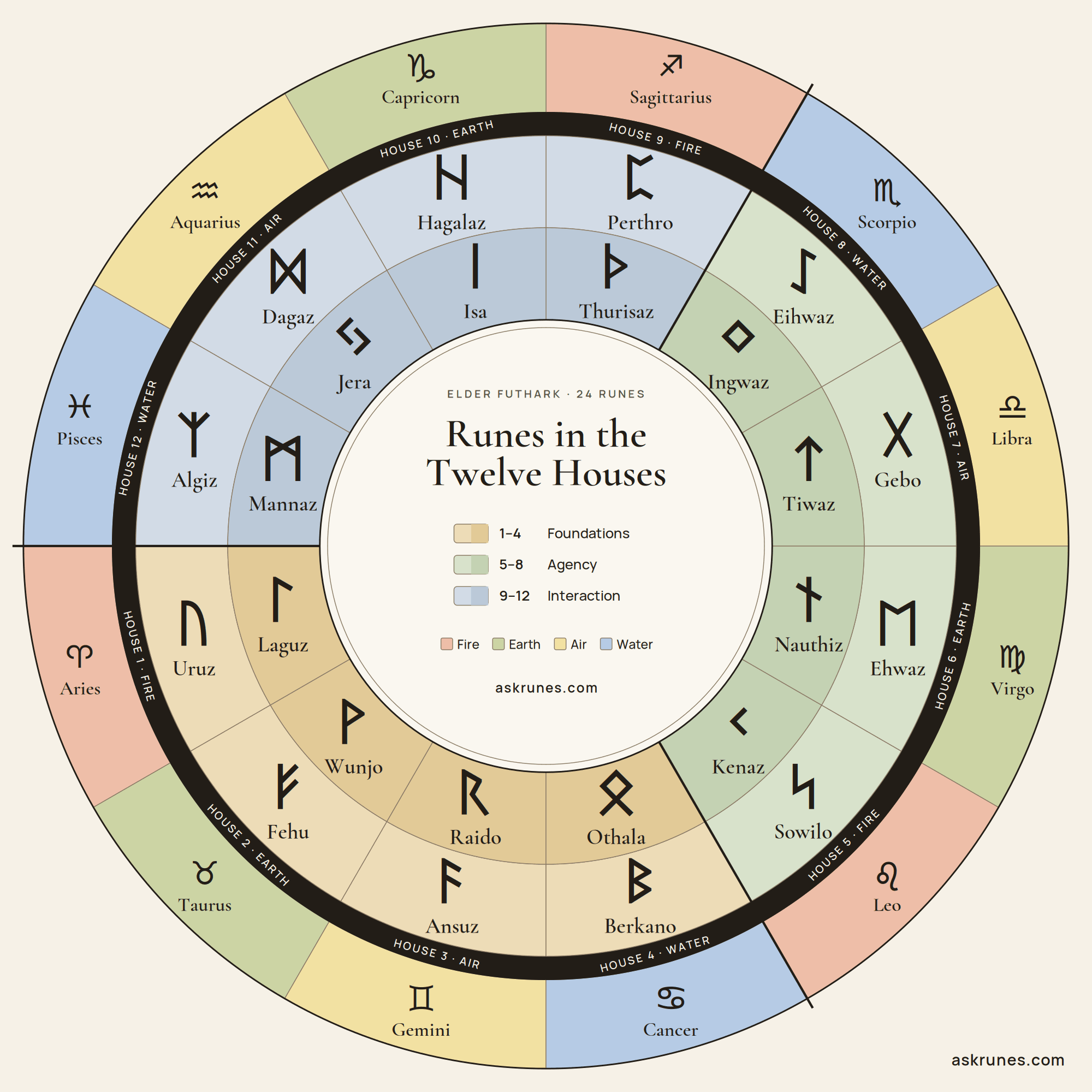
The AskRunes rune wheel. Click to open it full size, or download the printable PDF with each rune's meaning.
In this guide: How the rune wheel works · Three signs that shape every sign · The twelve stages · Why other rune–zodiac systems differ · How to use the wheel · Frequently asked questions
How the Rune Wheel Works
A wheel of twelve stages
The rune wheel treats the zodiac as a cycle that every situation passes through. Something begins as a raw impulse (the first house), finds the resources it needs (the second), learns what it has to know (the third), and so on around the wheel until, in the twelfth house, it dissolves into something larger than one person.
Each sign is linked to the house of the same number: Aries to the first, Taurus to the second, and so on. This is the natural zodiac, not your birth chart. When we talk about "Aries runes", we mean the runes of the first stage of the cycle, which every person passes through whenever they start something new. If you are an Aries, this stage is simply your home ground.
A note on what this is. The runes are far older than their meeting with astrology in the North, and no ancient source pairs them with zodiac signs. The rune wheel is AskRunes' own interpretive system. It is built on one principle, applied to all twelve signs: each rune stands where its meaning does the most work.
Three zones
The twelve stages fall into three zones of four.
• Foundations (houses 1–4): what sustains us. Energy, resources, basic knowledge, home. The ground we stand on, mostly without thinking about it.
• Agency (houses 5–8): how we act. Creativity, work, relationships, transformation. Here we make choices and change the world around us.
• Interaction (houses 9–12): how the world shapes us. The unknown, hard limits, freedom and the forces beyond one person's control.
Inside each zone the elements follow the same order: fire, earth, air, water. Fire starts a movement, earth gives it form, air brings understanding, and water gathers what has been lived.
Two rings: outside and within
On the wheel, each house holds two runes on two rings. The outer rune shows how the stage shows itself: what you can see, do or meet in the world. The inner rune shows how it works within: the measure, the motive, the mechanism behind the visible part.
The two runes are not synonyms. Each one completes the other, and each one on its own goes wrong in a recognisable way. In the first house, Uruz is raw force and Laguz is the instinct that gives it a channel. Uruz without Laguz is energy that spills everywhere and burns out. Laguz without Uruz is a sense of direction with no push behind it.
One rune, many faces
Every rune carries several layers of meaning, and the wheel does not erase them. A rune's place in the wheel shows which face of it works in that house.
Take Tiwaz, the rune of the god Tyr. Tyr was identified with Mars (Tuesday is Tiw's day, the Germanic version of the Latin day of Mars), so Tiwaz is a warrior's rune: focused action, courage, the strike that hits its target. But Tyr was also the god of the assembly, where disputes were settled, and his best-known myth is about keeping a pledge at great personal cost. On the wheel, Tiwaz stands in Libra, the house of agreements, because there its face of justice and commitment does the most work. Its warrior face has not gone anywhere. It is simply what Aries meets across the axis.
This is also why rune advice for a sign can reach beyond its own pair. The runes a sign works with in practice can come from any part of the wheel. The pair is the sign's fixed place in the system.
Three Signs That Shape Every Sign
No sign works alone. Each one is shaped by three others: the sign that follows it, the sign opposite, and the sign that comes before.
• The next sign is a resource. It is what feeds the current stage and carries it forward. For Aries, this is Taurus: the resources to sustain a new start, and a sense of when it is enough.
• The opposite sign is a counterweight. It describes the other side of the same question and keeps the sign from becoming one-sided. But it has a limit: when a sign leans on its opposite too much, the counterweight starts to replace its own function. For Aries, Libra teaches it to take other people into account. Taken too far, Aries stops acting at all without someone else's permission.
• The previous sign is a blind spot. It influences the sign from behind, where it is hardest to see. For Aries, this is Pisces: the quiet support behind every leap, which Aries rarely turns around to notice.
For Aries, the three look like this:
| Direction | Sign | Runes | Question for Aries |
|---|---|---|---|
| Resource | Taurus | Fehu, Wunjo | What will sustain what I start, and when is it enough? |
| Counterweight | Libra | Gebo, Tiwaz | Do I need to agree on this, or am I asking permission to want it? |
| Blind spot | Pisces | Algiz, Mannaz | Whose support am I taking for granted? |
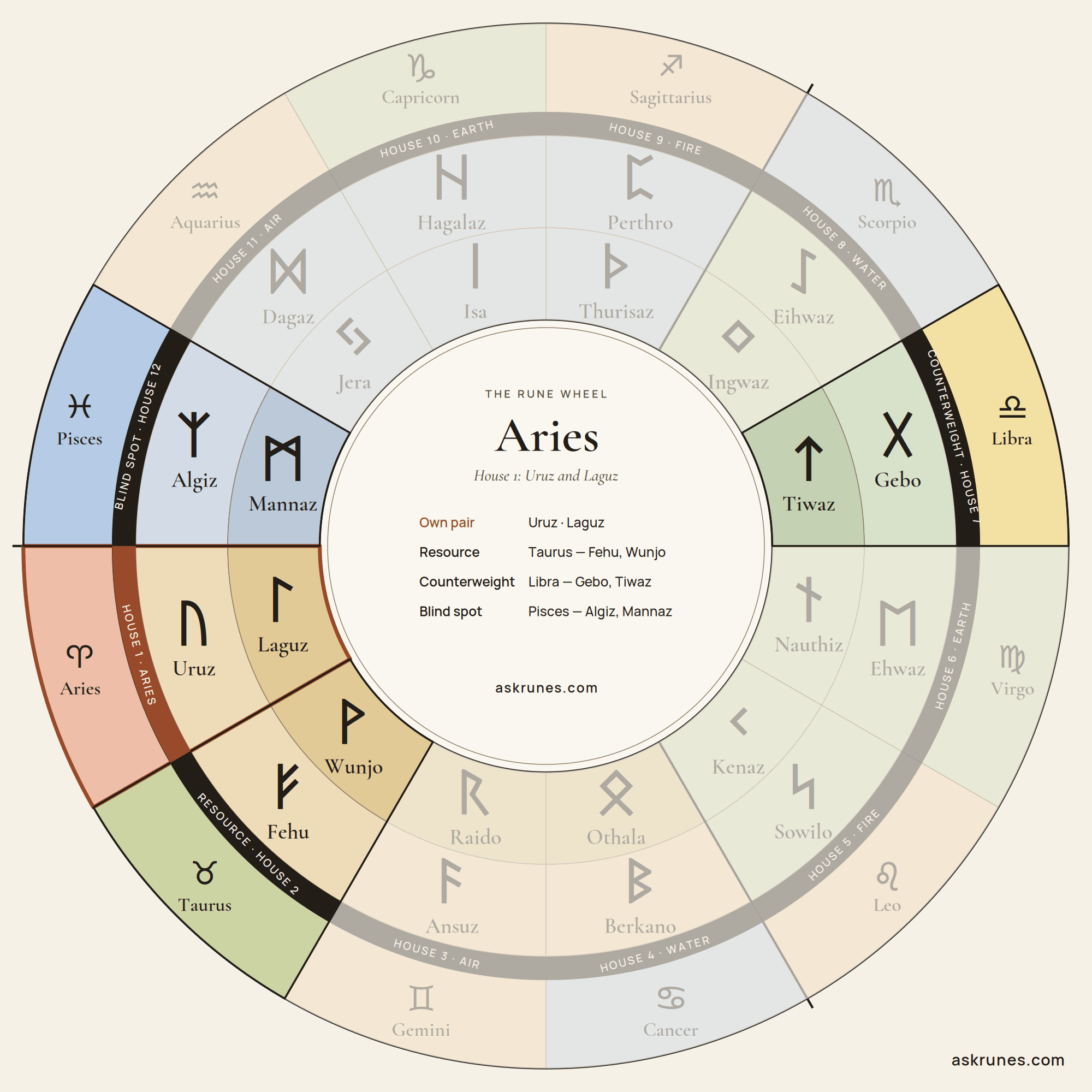
Every sign article includes its own wheel, like this one for Aries.
The six axes
Opposite signs form six axes. Each one is a single life question seen from two sides, and each side can tip over in its own way.
| Axis | The question | When it tips over |
|---|---|---|
| Aries — Libra | Your own initiative and mutual commitments | Ignoring the other person, or waiting for their approval before doing anything |
| Taurus — Scorpio | Securing what you need and changing what has run its course | Holding on to everything, or destroying a needed foundation for the sake of change |
| Gemini — Sagittarius | Tested knowledge and meeting the unknown | Trusting only the familiar, or accepting the unknown on faith |
| Cancer — Capricorn | A supporting base and the demands of reality | Hiding from the world in safety, or giving up all rest and support to meet its demands |
| Leo — Aquarius | Personal will and freedom that respects others | Imposing your wishes, or keeping such distance that you lose real interest |
| Virgo — Pisces | What you can handle yourself and what needs help | Trying to control the uncontrollable, or handing others what you could do yourself |
The Twelve Stages
Aries: Uruz and Laguz
The first house is wanting before knowing what. Uruz, the wild aurochs, is the raw force to begin; Laguz, the rune of water, is the instinct that tells that force where to flow. Aries rarely lacks fire. It loses fire, and Laguz is the rune that stops the loss.
Read: Aries and the Rune Wheel →
Taurus: Fehu and Wunjo
The second house is what we need to keep living. Fehu is the resource itself, the wealth that has to circulate to be worth anything. Wunjo is contentment, the inner sense of enough. Without Wunjo, Fehu turns into endless gathering.
Read: Taurus and the Rune Wheel →
Gemini: Ansuz and Raido
The third house is the knowledge we receive and pass on. Ansuz is the spoken word; Raido, the ride, is the road on which that word is tested. Gemini learns fast, and its lesson is to check whether what it learned actually leads anywhere.
Read: Gemini and the Rune Wheel →
Cancer: Berkano and Othala
The fourth house is the shelter where we belong. Berkano, the birch, is care that lets things grow; Othala, inherited land, is everything we received from our family without choosing it. A healthy home is a birch on old land: new shoots from deep roots.
Read: Cancer and the Rune Wheel →
Leo: Sowilo and Kenaz
The fifth house begins when basic needs are met: free energy, play, creativity, the life of the self. Sowilo, the sun, is the self shining outward; Kenaz, the torch, is the creative fire within. Fire lights the way, and it also burns the careless hand.
Read: Leo and the Rune Wheel →
Virgo: Ehwaz and Nauthiz
The sixth house turns a wish into a working method. Nauthiz, the rune of need, chooses what is truly necessary and discards the rest. Ehwaz, the horse, is the tool and the helper, and the skill that grows between rider and horse through trial and error.
Read: Virgo and the Rune Wheel →
Libra: Gebo and Tiwaz
The seventh house is the meeting of two independent people. Gebo is the gift and the exchange; Tiwaz is fairness and the word that holds. Exchange without fairness becomes a deal; fairness without exchange becomes a contract with no warmth in it.
Read: Libra and the Rune Wheel →
Scorpio: Eihwaz and Ingwaz
The eighth house is where results are counted and things change form. Eihwaz, the yew, the tree of graveyards and of long life, is transformation. Ingwaz, the seed, is what stays whole through the change.
Read: Scorpio and the Rune Wheel →
Sagittarius: Perthro and Thurisaz
The ninth house opens the door to the unknown: foreign ideas, offers, beliefs. Perthro, the lot-cup, is chance and temptation, the thrill of what we do not yet understand. Thurisaz, the rune of the giants who defied the gods, is the strength not to be swept away.
Read: Sagittarius and the Rune Wheel →
Capricorn: Hagalaz and Isa
The tenth house is reality as it is: limits, responsibility, career. Hagalaz, hail, is the blow that breaks what was not built to last. Isa, ice, is the endurance to hold one's shape, and in excess, the rigidity that cannot bend.
Read: Capricorn and the Rune Wheel →
Aquarius: Dagaz and Jera
The eleventh house brings freedom after the pressure of the tenth: discovery, new ideas, a wider sense of humanity. Dagaz, daybreak, is the breakthrough. Jera, the harvest, is the patience of a sign that has to learn every new idea has its own season.
Read: Aquarius and the Rune Wheel →
Pisces: Algiz and Mannaz
The twelfth house goes beyond one person. Algiz is protection, a sedge that wounds whoever tries to seize it. Mannaz is humankind, the people we depend on without seeing them. At the end of the cycle, rescue comes through others, and through the help we once gave.
Read: Pisces and the Rune Wheel →
Why Other Rune–Zodiac Systems Differ
If you have seen other charts, you will notice they rarely agree. That is not because some are right and others wrong. They are answering different questions.
Sequential systems walk through the futhark in order, giving runes to signs or to half-month periods of the year. They are easy to follow, but a rune's position depends on its number, not its meaning. Birth runes usually work this way.
Associative systems match runes to signs by resemblance: a fiery rune for a fire sign, a warrior's rune for Aries. They feel natural, but often leave some runes out and give others to several signs.
Functional systems, like the rune wheel, ask what each rune does and which stage of life needs exactly that. The results can surprise: water in Aries, the harvest in airy Aquarius. But every placement has a reason, and every rune is used exactly once.
Our guides to the individual signs, such as Aries and Norse Runes, take a practical angle: which runes support a sign's strengths in talismans and everyday work. Those suggestions can come from anywhere on the wheel. The rune wheel describes something else: each sign's fixed place in the cycle.
How to Use the Wheel
For reflection. Pick an area of your life, find its stage on the wheel, and read both runes together. With money, for instance, Fehu and Wunjo ask: do I lack resources, or have I lost the sense of enough? Then look at the three neighbouring signs for the resource, the counterweight and the blind spot.
In readings. When a rune appears in a rune spread, its house can suggest the area of life it points to. Isa in a question about work speaks with the voice of the tenth house; Isa in a question about love may be pointing at a relationship that is holding its shape at the cost of warmth.
For practice. You can combine a sign's pair, or add a rune from its counterweight, in the Bindrune Generator.
Frequently Asked Questions
Q: Is there one official rune for each zodiac sign?
A: No. The runes and the zodiac come from different traditions, and every link between them is modern. The rune wheel is AskRunes' own interpretive system.
Q: Why do different websites give different runes for the same sign?
A: They use different principles: the order of the futhark, the calendar, or resemblance between symbols. The rune wheel places each rune by what it does.
Q: Is my zodiac rune the same as my birth rune?
A: Not necessarily. Birth runes are usually assigned by date, following the calendar. The rune wheel describes stages of life. You can use both, for different questions: see the Birth Runes Guide or try the free Birthday Rune Reading.
Q: Why two runes for each sign?
A: Because every stage of life has an outward side and an inner mechanism. Twenty-four runes fill those twenty-four places exactly, so every rune is used once.
Q: Do I need my birth time or birth chart?
A: No. The wheel is a symbolic map, not a natal chart. You only need a question and the stage of life it belongs to.
Q: I'm not the sign I'm reading about. Is it still for me?
A: Yes. Everyone passes through all twelve stages. Whenever you start something, you are in Aries; whenever you go home, you are in Cancer.
Put the theme into practice
Build a Rune Combination Around a Real Goal
Instead of choosing runes only because they match a personality theme, start from the change you want to focus on and give every rune a separate job.
Modern intention-based rune combinations and staves are contemporary interpretive practices, not surviving historical formulas.
Reviewed by Sofia Veles, intuitive tarot & rune reader
Back