

Taurus and the Rune Wheel: Fehu, Wunjo and the Measure of Enough
Three people, three salaries. The first saves every spare coin and still lies awake worrying about money. The second spends everything the week it arrives and is surprised, every month, by how little is left. The third earns more than the other two put together and says, without irony, that they cannot afford to slow down.
They look like opposites. They share one problem, and it is the problem of the second house: none of them knows what enough looks like.
In the AskRunes rune wheel, the second house belongs to Taurus and holds two runes: Fehu, the rune of wealth, and Wunjo, the rune of joy. The first is what you have. The second is the feeling that tells you it is enough. Taurus is famous for the first. Its real lesson is the second.
The Second House: What We Need to Keep Going
The first house wants. The second house asks what that wanting will cost. It is where an impulse meets necessity: food, rent, tools, time, a body strong enough to carry the plan. Before anything can grow, something has to sustain it.
That is why the second house is not the house of greed, whatever its reputation. It is the house of the necessary, and it asks two questions. What kind of resources do I need? And how much of them? Fehu answers the first question. Wunjo answers the second, and it is the one most people skip.
Fehu and Wunjo: Having and Having Enough
Fehu: wealth that moves
Fehu means cattle, and for the people who carved it, cattle were wealth that walked. You could drive it to market, trade it, give it as a dowry or lose it to a raid. It was never still.
The rune poems are candid about what such wealth does. The Old English poem calls it a comfort to everyone, then adds a condition: it has to be shared freely if its owner wants honour. The Norwegian poem is darker. It says wealth causes quarrels among kin. Both poems know the same thing: a resource is only good while it is being used well.
In the second house, Fehu is the outer rune: money, but also time, skills, energy, a network of people who will help. Anything you can spend on your life belongs to Fehu.
Wunjo: the joy of enough
Wunjo is joy, and the Old English poem describes it in surprisingly plain terms: the joy of someone who knows little pain or sorrow and has prosperity, happiness, and a sufficient home. The poem's idea of bliss ends with enough, not with more.
In the second house, Wunjo works from within as a sense of measure. It is not the instruction to want less. It is the moment you notice that one more thing will add nothing, and the pleasure of stopping there.
Fehu tells Taurus what it has. Wunjo tells it when to stop counting.
Three people, one missing rune
Go back to the three people from the beginning. Each one has lost the balance between the two runes in a different way.
The saver has Fehu that does not move: cattle locked in the barn. Wunjo never arrives, because no amount in the account ever feels like enough to stop worrying.
The spender has Wunjo cut off from Fehu. The joy is real, but it is not tied to any lasting resource, so it disappears with the money.
The high earner has Fehu growing without Wunjo. The line of enough moves every time it comes into view: a bigger flat, a better car, a safer margin. The resources pile up and the life they were meant to pay for waits.
In a healthy second house, the two runes measure each other. Resources are sized to the life you actually live, and that life is actually enjoyed.
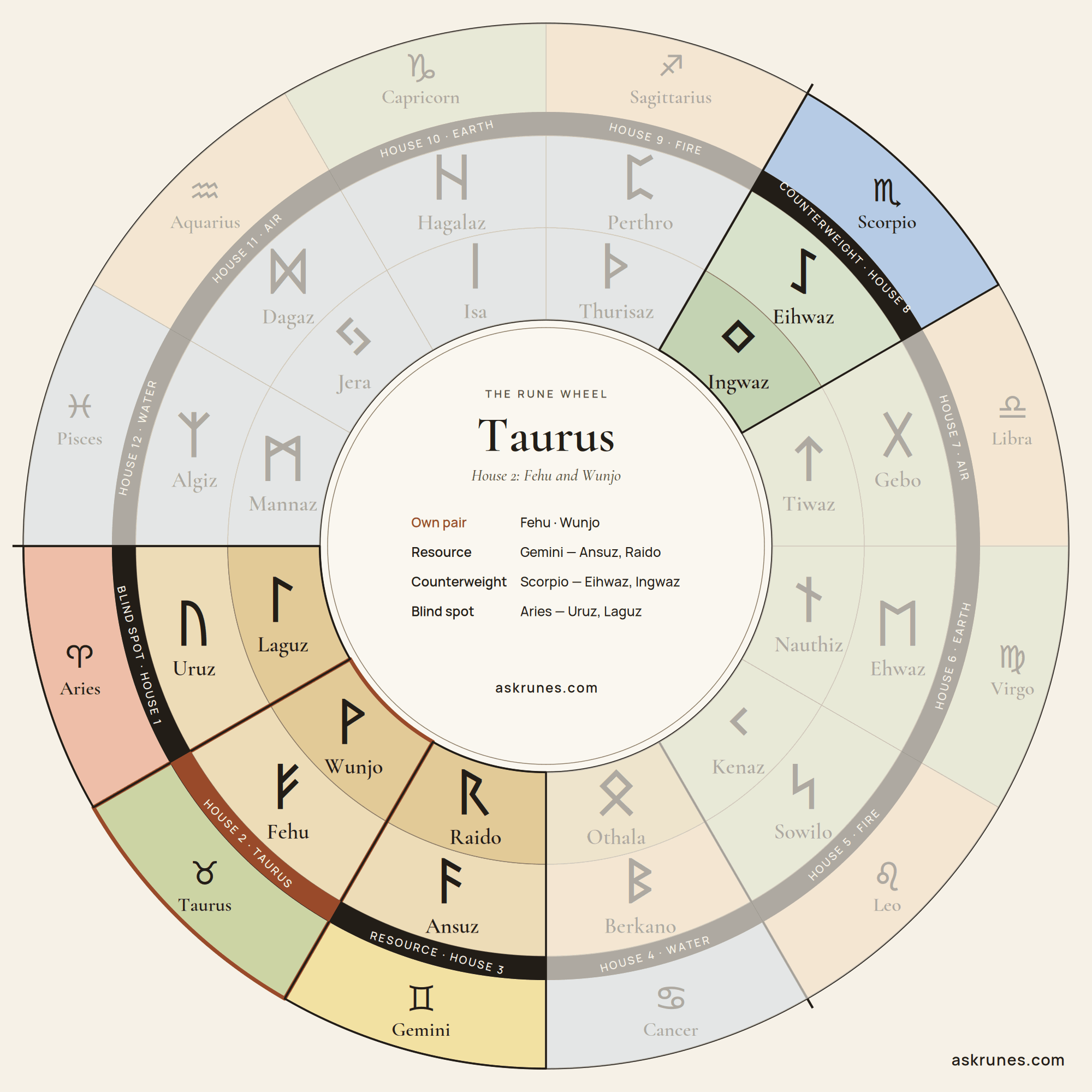
Taurus on the AskRunes rune wheel: Scorpio opposite, Aries behind, Gemini ahead.
Scorpio Opposite: The Grain and the Seed
Opposite Taurus stands Scorpio, with Eihwaz, the yew, and Ingwaz, the seed. Taurus keeps. Scorpio asks what has already done its work.
Every farmer knows the answer to this axis. Part of the harvest is eaten, and part is kept back as seed. A farmer who eats all the grain has nothing to sow next spring. A farmer who keeps the seed in the barn, because burying it feels like losing it, ends up in exactly the same place. Ingwaz is that seed: life stored whole, which grows only if you let it go into the ground.
Eihwaz, the yew, adds the second half of the lesson. The yew was planted in graveyards and lives for many centuries: a tree of endings and of great age at once. Things last on this axis not by being kept forever, but by being allowed to end at the right time.
For Taurus, the Scorpio lesson sounds like this: the job that pays well but has gone dead, the things kept "just in case" for fifteen years, the habit of treating a person or a role as a possession. Keeping them is not security. It is grain that will never become seed.
Where the counterweight ends
The opposite mistake is just as real. Scorpio taken too far burns the barn. Selling everything in a crisis to "start again", leaving a stable income with no plan because stability suddenly feels like a prison, decluttering until you no longer have what you need: these are not transformation. They are the loss of the second house.
A test for the axis: Is this thing finished, or am I just tired of looking after it?
Scorpio's side of this axis is told in Scorpio and the Rune Wheel.
Aries Behind: The Wish Taurus Forgets
The sign before Taurus is Aries, with Uruz and Laguz, and it is Taurus' blind spot. Every resource once started as a wish. Taurus is so good at keeping that it can forget what the keeping was for.
You see it in money saved for a journey that never happens, in a house bought for a family life nobody has time to live in, in a skill collected with certificates and never used. The resource is there. The impulse that gave it meaning has been lost somewhere behind.
Uruz has another warning for Taurus. It is the rune of raw vitality, the body's own strength, and it is the resource Taurus most often spends without counting. Working one more year to be safe, and one more after that, is paid for in health. Laguz, the instinct that knows when to move, is what tells Taurus the moment to use what it has gathered has come.
Ask yourself: What did I want this for, and when do I actually plan to use it?
Gemini Ahead: Resources That Talk
The sign after Taurus is its resource, and it is not more storage. It is Gemini, with Ansuz, the spoken word, and Raido, the road.
Taurus has a quiet weakness: it rarely names its value. It undercharges, waits to be offered a raise instead of asking, assumes good work will speak for itself. Ansuz is the voice Taurus needs: to ask, to set a price, to tell people what it can offer. A resource nobody knows about is worth very little.
Raido is the road to market. Fehu was always wealth that could travel, and Raido keeps it travelling: trade, exchange, learning something new that opens a new way to earn. A skill you have learned is the one resource no raid can take.
Ask yourself: Who needs to hear what I have to offer, and have I told them?
For the full picture of this stage, read Gemini and the Rune Wheel.
A Practice: Drawing Your Line of Enough
Choose one area of your life: money, time, possessions or work. Take a sheet of paper and write three short lines:
• What I need: the level below which life really becomes harder.
• What would be enough: the level at which you would stop and enjoy what you have. Be concrete.
• What I keep in reserve: and for what.
Now list what you keep that fits none of the three lines. That list belongs to Scorpio: things that may have finished their work. Then ask one Wunjo question: when did I last enjoy what I already have?
If you want a reminder of the line you drew, combine Fehu and Wunjo in the Bindrune Generator. For practical rune work with this sign, see our guide to Taurus and Norse Runes, and for a question about your own resources, try a rune spread.
Frequently Asked Questions
Q: Is the second house only about money?
A: No. Money is simply the easiest resource to count. Time, health, skills, energy and the people you can rely on all belong to the second house, and the same question of enough applies to each of them.
Q: Does Wunjo mean I should want less?
A: Not necessarily. Wunjo is not about wanting little; it is about knowing when what you have is enough to enjoy. For some people that means earning more, for others it means stopping sooner.
Q: Why is Scorpio, a sign of endings, opposite Taurus?
A: Because keeping and letting go are one question seen from two sides. Taurus secures what is needed; Scorpio releases what has run its course, so that something new can grow. Each keeps the other from going to extremes.
Q: I'm not a Taurus. Does this apply to me?
A: Yes. Whenever you decide what you need, how much is enough, or what to do with what you have, you are in the second house, whatever your sign.
Put the theme into practice
Build a Rune Combination Around a Real Goal
Instead of choosing runes only because they match a personality theme, start from the change you want to focus on and give every rune a separate job.
Modern intention-based rune combinations and staves are contemporary interpretive practices, not surviving historical formulas.
Reviewed by Sofia Veles, intuitive tarot & rune reader
Back