

Scorpio and the Rune Wheel: Eihwaz, Ingwaz and the Wall That Holds the Roof
Anyone who has renovated an old house knows the moment. The plaster is off, the floor is up, the wiring hangs out of the walls, and for a few weeks the house is less liveable than before anyone touched it. Some people panic and stop. Others get carried away and start knocking down walls.
The good builders do neither. They strip everything that has to go, and they know exactly which wall is holding up the roof.
That is Scorpio's craft, and the AskRunes rune wheel gives it two runes. In the eighth house stand Eihwaz, the yew, the rune of transformation, and Ingwaz, the seed, the rune of what stays whole. One takes the old form apart. The other is the load-bearing wall.
The Eighth House: Where Results Are Counted
The seventh house brings another person into our life. The eighth house counts what came of it. Shared money and shared debts, inheritance, intimacy, the things we built with others and the things we lost: this is where the results of the first seven houses are added up.
A result is always an ending of some kind. A project is finished, a chapter closes, a relationship changes its form or ends. That is why the eighth house has a reputation for crisis and death. Its real subject is simpler and harder: seeing honestly what has happened, and changing accordingly.
Scorpio's intensity comes from here. It is the sign that looks at the result without flinching, and it knows that after an honest count, something usually has to change.
Eihwaz and Ingwaz: Change the Form, Keep the Core
Eihwaz: the tree that bends and lasts
Eihwaz is the yew. The Old English rune poem describes it as a tree with rough bark, hard and firmly rooted, a keeper of fire. The yew is full of contradictions that suit Scorpio well. Almost every part of it is poisonous, yet it is among the longest-lived trees in Europe. Its wood is hard, yet for centuries it was the wood of choice for longbows, because it bends a long way without breaking.
As the outer rune of the eighth house, Eihwaz is visible transformation: the crisis, the ending, the moment the old shape gives way. And the longbow is the best picture of how it should happen. Real transformation bends a person almost to the limit and does not snap them.
Ingwaz: the whole that goes away and comes back
Ingwaz is the rune of Ing, a god of fertility. The Old English poem tells how Ing was first seen among the East Danes and then went away over the waves, his wagon following behind him. It is a story of departure, and of something that goes into hiding whole rather than being destroyed.
Its shape says the same: a closed figure with nothing leaking out. As Scorpio's inner rune, Ingwaz is the core that survives change. Values, identity, health, the sense of who you are: a balanced system that can go underground for a while and come back. It is also the measure that keeps transformation from becoming destruction.
Eihwaz changes the form. Ingwaz keeps what the form was protecting.
When one works without the other
Eihwaz without Ingwaz is transformation with no core to protect. Bridges burned every few years, a life reinvented again and again, crisis as a way of feeling alive. Everything changes, and because nothing is kept, nothing grows. This is the Scorpio who confuses destruction with depth.
Ingwaz without Eihwaz is the seed that is never planted. A closed system that never opens: secrets kept for decades, feelings held so tightly that no one ever sees them, a self-sufficiency that has quietly become isolation. Nothing is lost, and nothing is renewed. Ing has gone over the waves and does not come back.
The healthy eighth house is the good renovation: the old plaster gone, the load-bearing wall untouched, a house that is the same house and entirely new.
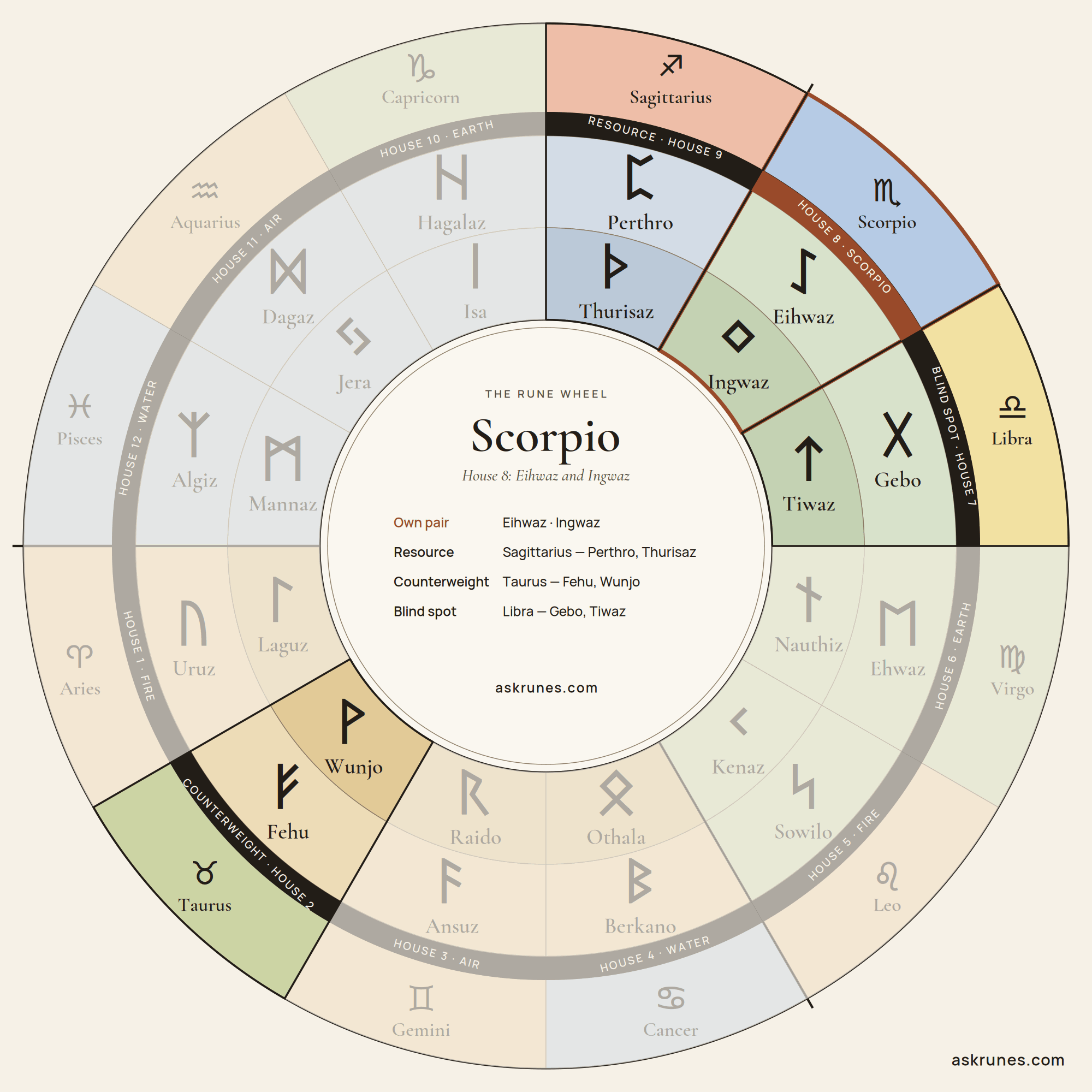
Scorpio on the AskRunes rune wheel: Libra before it, Taurus across, Sagittarius beyond.
Before: Libra and the Promises That Survive Change
The sign before Scorpio is Libra, with Gebo and Tiwaz, and it is Scorpio's blind spot.
Scorpio experiences its transformations as deeply personal: my crisis, my ending, my rebirth. But almost everything the eighth house changes was built with other people. A shared flat, a joint account, a business, children, years of a friendship. Gebo reminds Scorpio that others have a share in what it is about to transform, because they gave to it too.
Tiwaz is sharper still. I am a different person now is often true after a crisis, and it does not cancel what that person promised. Debts, agreements and obligations tend to outlive the self that made them. A Scorpio who burns everything down and walks away clean usually leaves someone else to pay for the fire.
Ask yourself: Who else has a share in what I am about to change, and what did I promise them?
For Libra's own view of this, read Libra and the Rune Wheel.
Across: Taurus and the Things Worth Keeping
Opposite Scorpio stands Taurus, with Fehu and Wunjo. The axis between them is one question seen from two sides: what do I secure, and what do I let go?
Scorpio's instinct is to strip everything down to its essence. Taurus answers that some things do not need to be transformed. They simply need to be kept, because they feed life: the steady income, the familiar home, the ordinary pleasures. Wunjo, simple joy, is what Scorpio most easily dismisses as shallow. A good meal, a warm evening, a day with nothing at stake. These are not a distraction from depth. They are what makes it bearable.
Scorpio's own excess is the one the axis warns against: destroying a needed foundation for the sake of change. Leaving the job, the relationship and the city in one month because one of them has become unbearable. Taurus asks for a slower cut.
Where the counterweight ends
Taurus can be overdone from Scorpio's side too. The fear of loss can keep Scorpio in something that has plainly died: a dead marriage kept for the house, a dead job kept for the pension, a way of life kept because the alternative is unknown. Then keeping is not wisdom. It is refusing to count the result.
A test for the axis: Am I keeping this because it still feeds my life, or because I am afraid of what is underneath it?
For the other side of this axis, read Taurus and the Rune Wheel.
Beyond: Sagittarius and the Meaning After the Crisis
The sign after Scorpio is its resource: Sagittarius, with Perthro and Thurisaz. What feeds a transformation is not more intensity. It is a horizon.
A crisis without meaning is just damage. The ninth house is the house of meaning: beliefs, long journeys, the wider view in which a personal ending becomes part of a larger story. People come through the same loss very differently, and much of the difference lies in whether they can see where it might lead.
Perthro, the lot-cup, brings the hard part. When the old form is gone, the new one cannot be known in advance. Scorpio loves control, and Perthro asks it to throw the dice anyway. Thurisaz, the rune of the giants who defied the gods, is the force to walk out into that unknown, carrying the energy released by the crisis into new ground instead of turning it back on itself.
Ask yourself: What did this ending make possible that was not possible before?
Sagittarius' own story is told in Sagittarius and the Rune Wheel.
A Practice: Two Sentences
Think of one thing in your life that has recently ended or is ending now: a job, a relationship, a habit, a version of yourself. Write two sentences, and only two.
The first begins with "What ended was…" Name it honestly, and if you can, thank it for what it gave you. That is Eihwaz.
The second begins with "What continues is…" Name what came through the change whole: a value, a skill, a friendship, a part of you that nothing touched. That is Ingwaz.
If the second sentence was hard to write, the change may have gone deeper than it needed to. If the first one was, it may not be over yet.
You can combine Eihwaz and Ingwaz in the Bindrune Generator. For practical rune work with this sign, see our guide to Scorpio and Norse Runes, and for a question about a change in your own life, choose a rune spread.
Frequently Asked Questions
Q: Is the eighth house about death?
A: Only symbolically, for the most part. It is the house of results and endings: what came of a shared venture, what was lost, what remains, and how we change afterwards. Shared money, inheritance, intimacy and crisis all belong here.
Q: Why is Ingwaz, a rune of fertility, in Scorpio?
A: Because in the eighth house, fertility means survival. Ingwaz is the seed, a whole life kept safe inside a closed shape. During a transformation, it is the core that must not be lost.
Q: Our Scorpio guide recommends Perthro. Why isn't it Scorpio's rune here?
A: On the wheel, Perthro belongs to Sagittarius, the sign right after Scorpio, and that makes it Scorpio's resource. The Scorpio guide uses it for Scorpio's love of mystery; here it appears as the courage to throw the dice on a new beginning. Eihwaz, the other rune that guide names first, is Scorpio's own.
Q: I'm not a Scorpio. Does this apply to me?
A: Yes. Whenever you count the results of something, go through a crisis, or let an old form of your life end, you are in the eighth house, whatever your sign.
Put the theme into practice
Build a Rune Combination Around a Real Goal
Instead of choosing runes only because they match a personality theme, start from the change you want to focus on and give every rune a separate job.
Modern intention-based rune combinations and staves are contemporary interpretive practices, not surviving historical formulas.
Reviewed by Sofia Veles, intuitive tarot & rune reader
Back