

Libra and the Rune Wheel: Gebo, Tiwaz and the Weight on Both Sides
"Where shall we eat?" "I don't mind, you choose." "No, really, you choose." "Honestly, anywhere is fine." Twenty minutes later, two hungry people are still standing on the pavement, each politely waiting for the other to want something.
It looks like harmony. It is actually a scale with nothing on either pan. Libra, the sign of balance, knows this scene better than anyone, and its whole lesson is hidden inside it: you cannot balance two weights if neither person is willing to put theirs down.
In the AskRunes rune wheel, the seventh house belongs to Libra and holds two runes: Gebo, the gift, and Tiwaz, the rune of Tyr. Gebo is what passes between two people. Tiwaz is the promise that holds it together.
The Seventh House: The First House of "We"
The first six houses are about one person: their strength, their needs, their knowledge, their home, their joy, their work. In the seventh house someone else walks in, and they are not a helper or an audience. They are another independent person, with a will of their own.
That is what unites everyone the seventh house covers: a spouse, a business partner, the other side of a contract, and, less obviously, an open rival. A partner and an opponent have one thing in common. Both stand on equal ground with you, and neither can simply be told what to do. Something has to be agreed.
Gebo and Tiwaz: The Gift and the Promise
Gebo: nothing given is ever free
Gebo is the gift, and in the Norse world a gift was never a simple thing. The Hávamál, the poem of Odin's advice, tells its listeners to repay a gift with a gift, and warns that a gift always looks for something in return. To accept a gift was to enter a bond.
The Old English rune poem shows the other side: generosity brings honour to the giver and is the only support of those who have nothing else. Giving builds a person's standing precisely because it creates ties.
As Libra's outer rune, Gebo is everything visible that passes between two people: attention, help, money, favours, time, affection. It is the living exchange that makes a relationship feel like one.
Tiwaz: the star that keeps faith
Tiwaz is often read as a warrior's rune, but the Old English poem describes it as something else entirely: a guiding star that keeps faith, always on its course through the night, never failing. It is a picture of reliability, of someone whose word you can steer by.
The Norse poems remember Tyr as the one-handed god, and the missing hand is the price of a pledge he kept. As Libra's inner rune, Tiwaz is the law inside a relationship: what we have agreed, spoken or unspoken, and whether we keep it when it becomes inconvenient.
Gebo is what we give each other. Tiwaz is what we can count on.
When the gift and the promise come apart
Gebo without Tiwaz is warm, generous and dangerous. Favours pile up without anyone saying what they mean. Expectations grow in silence. Then one day comes the sentence every relationship dreads: after everything I have done for you. The score was being kept all along. It just was never agreed.
Tiwaz without Gebo is fair and cold. Every bill split to the cent, every duty written down, every conversation a negotiation. Nobody is cheated and nobody is warm. A marriage run like a contract is correct, but there is nothing in it anyone would want to keep.
The healthy seventh house is a warm exchange inside a frame both people trust: generous because it is safe, and safe because both keep their word.
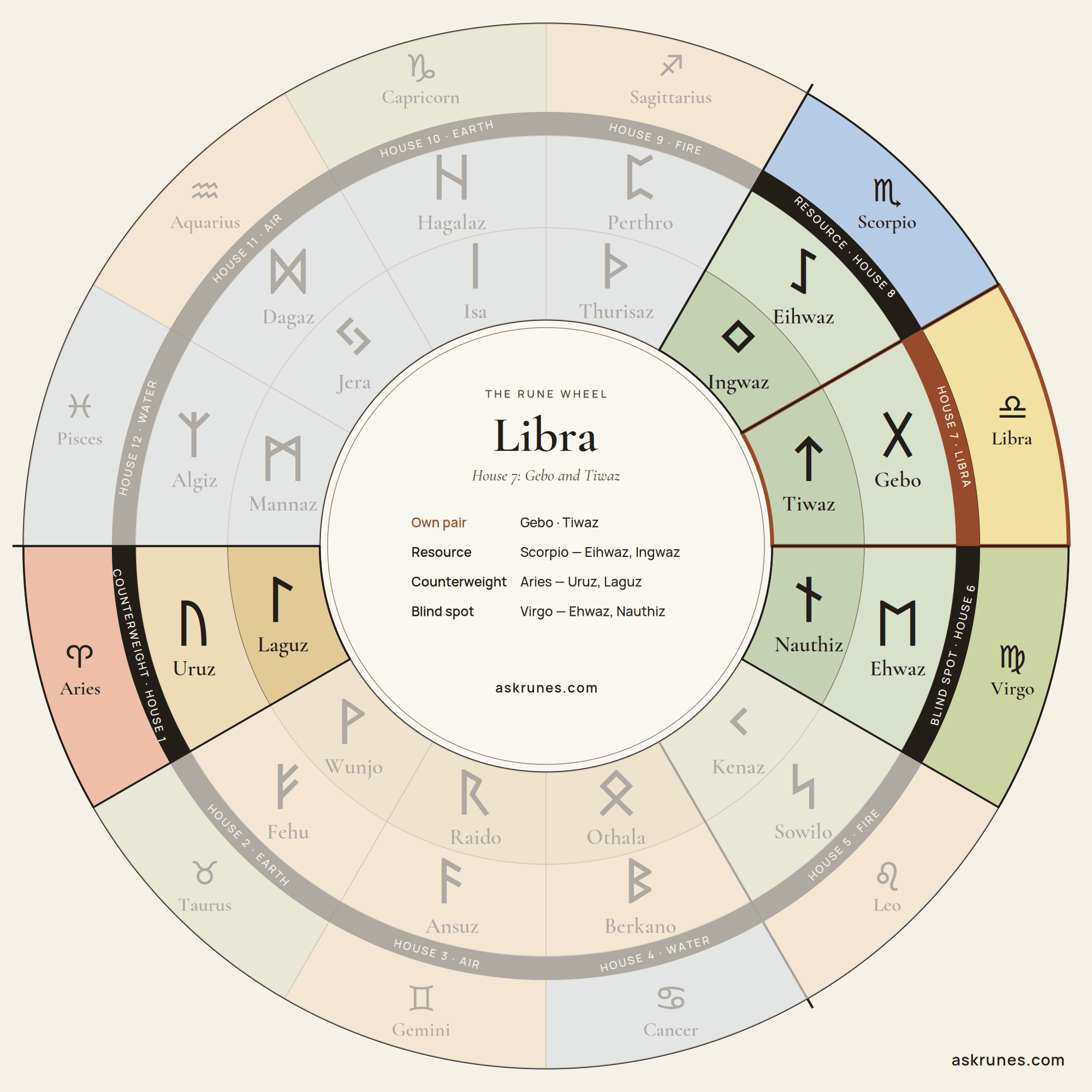
Libra on the AskRunes rune wheel: Virgo behind, Scorpio ahead, Aries opposite.
Lesson One: Harmony Is Daily Work (Virgo, the Blind Spot)
The sign before Libra is Virgo, with Ehwaz and Nauthiz, and it is where Libra looks least. Libra thinks relationships are held together by understanding: good conversations, shared values, feeling in tune. They are held together at least as much by the dull daily mechanics nobody talks about. Who takes the rubbish out. Who remembers the dentist. Who notices that the fridge is empty.
Ehwaz is that mechanism: the practical routine of two people living or working side by side. When it runs smoothly, nobody sees it. When it breaks, no amount of talking about feelings will fix it.
Nauthiz brings the harder part. The Norwegian rune poem says that need leaves little choice. Libra, which loves peace, tends to postpone whatever is unpleasant: the difficult conversation, the awkward question about money, the complaint that might cause a scene. But what a relationship needs does not stop being needed because it is uncomfortable to say.
Ask yourself: What does this relationship need that I keep postponing because it is unpleasant?
Lesson Two: Depth Is a Resource (Scorpio, Ahead)
The sign after Libra is its resource: Scorpio, with Eihwaz, the yew, and Ingwaz, the seed.
Libra wants things to stay pleasant, so it avoids crises. Scorpio knows something Libra does not want to hear: relationships grow strongest by going through them. The yew is the tree of endings and of long life at once. A partnership that has survived an illness, a failure or a real quarrel, and come out the other side, has roots a merely pleasant one never grows.
Ingwaz is what two people make that neither could make alone: a child, a home, a business, a shared way of seeing things. It is a seed that holds a whole life inside it. Libra often measures a relationship by how balanced it feels today. Scorpio measures it by what it is growing.
Ask yourself: What have we built together that neither of us could have built alone?
For Scorpio's own lesson, read Scorpio and the Rune Wheel.
Lesson Three: Keep Your Own Weight on the Scale (Aries, Opposite)
Opposite Libra stands Aries, with Uruz and Laguz. This is where the dinner scene from the beginning is resolved.
Libra is so tuned to the other person that it can lose track of itself. It adapts, mirrors, asks what you would like, and quietly stops knowing what it would like. Aries answers with its own pair. Uruz is your own strength, the energy you bring into a relationship rather than borrow from it. Laguz is your own instinct, the gut sense of what you want before anyone else has spoken.
A scale only balances when there is weight on both pans. A relationship in which one person has disappeared is not harmonious. It is simply lighter on one side.
Where the counterweight ends
Aries can be overdone as well. Taken too far, standing up for yourself turns into deciding alone: booking the restaurant without asking, making the big choice and informing the partner afterwards. Then Libra has not found its balance. It has left the seventh house altogether.
A test for the axis: Do I know what I want here, before I ask what you want?
For the same axis seen from the other side, read Aries and the Rune Wheel.
A Practice: One "I Want" a Day
For one week, once a day, say out loud a preference that begins with I want or I'd prefer. Keep it small: which film, which café, which way to walk home. Notice how often the sentence wants to turn into a question on its way out.
Then, once during the week, have one Tiwaz conversation. Pick one agreement in an important relationship that has never been said out loud, about money, time, chores or anything else, and say it. Ask whether the other person sees it the same way.
You can keep the pair in view by combining Gebo and Tiwaz in the Bindrune Generator. For practical rune work with this sign, see our guide to Libra and Norse Runes, and for a question about a relationship of your own, choose a rune spread.
Frequently Asked Questions
Q: Is the seventh house only about romantic relationships?
A: No. It covers every relationship between equals: marriage, business partnerships, contracts, negotiations, and even open rivals. What they share is that the other person has their own will, so something has to be agreed.
Q: Isn't Tiwaz a warrior's rune? Why is it in Libra?
A: Tiwaz has several faces. Tyr was a war god, but also the god of the assembly where disputes were settled, and the Old English rune poem describes the rune as a star that keeps faith. On the wheel, that face of justice and reliability is the one that works in the seventh house.
Q: Why is Aries, the most independent sign, Libra's counterweight?
A: Because a relationship needs two whole people. Aries reminds Libra to bring its own strength and its own wishes to the scale. Without them, there is nothing to balance.
Q: I'm not a Libra. Does this apply to me?
A: Yes. Whenever you make an agreement, share something with a partner, or face someone as an equal, you are in the seventh house, whatever your sign.
Put the theme into practice
Build a Rune Combination Around a Real Goal
Instead of choosing runes only because they match a personality theme, start from the change you want to focus on and give every rune a separate job.
Modern intention-based rune combinations and staves are contemporary interpretive practices, not surviving historical formulas.
Reviewed by Sofia Veles, intuitive tarot & rune reader
Back